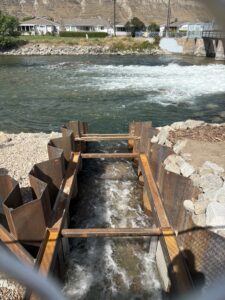

Project Overview:
In the late 1990s, the future of Okanagan salmon appeared bleak. Indigenous salmon populations had either been completely wiped out or were at alarmingly low levels. The loss of these salmon would have significant repercussions.
What led to this decline?
In the early 1900s, extensive flooding disrupted colonization efforts. To address this, the river was straightened, narrowed, and diked. A dam was constructed to regulate the flow from Okanagan Lake into the Okanagan River, altering the riverbed from gravel—ideal for salmon nests (redds)—to larger cobbles and sand. Essential habitats such as pools, riffles, eddies, and riparian zones were destroyed, resulting in a 50% reduction in the river’s length and the loss of 90% of riparian habitat.
With the river disconnected from its floodplain, it could no longer perform its ecological functions. The construction of McIntyre and Skaha Dams in the southern Okanagan further impeded salmon migration upstream. This transformed ecosystem could no longer sustain a large salmon population.
Restoring Salmonid Passage into kłusxnitk Okanagan Lake:
The main project goals are to enhance passage for indigenous salmonids throughout all migration periods, spanning from February to November, to ensure access to their historical spawning grounds. Additionally, the project aims to increase food security for all species, including humans, by fostering a sustainable and thriving ecosystem.
kł cp̓əlk̓ stim̓, cause to come back is an initiative to return salmon back to their waters, that were near the brink of extirpation. This has required tremendous effort. During 1996 ONA, with foresight, determination and resiliency, began years of advocacy, gathering partners and finding support, the end goal being to return the salmon to their historical territory. Over the last 20 + years, ONA has completed a 12-year Sockeye reintroduction program into Skaha Lake, which saw little impact on other species and completed about 50 habitat restoration and fish passage projects including building spawning beds, reconnecting the river with oxbows and side channels, modifications to McIntyre Dam (Oliver) and Skaha Dam (Okanagan Falls), increasing river bed diversity, and reconnecting former floodplains, all mitigating habitat lost during river channelization. To further assist rebuilding Okanagan salmonid populations, the ONA built a sockeye salmon conservation hatchery, kł cp̓əlk̓ stim̓, for release of fry into historical spawning areas.
Cultural Significance:
For the Syilx Okanagan people, this project is much more than infrastructure; it is a cultural reconnection of siwɬkʷ, water and the tmixʷ all living things. To have salmon be able to freely make their way into kłusxnitkʷ a reflection of deep responsibilities and relationships. Salmon, or ntytyix, are sacred to the Syilx people. They are considered relatives, not resources, and their return marks a powerful act of environmental and cultural healing.
Project Goals:
The goal was to create a nature-like fishway channel from the Okanagan River into Okanagan Lake, bypassing the Okanagan Lake Outlet Dam.
The Project:
-
Provides consistent velocities and depths through the fishway for all indigenous salmonids.
-
Provides an adjustable invasive species migration barrier to deter invasive passage into Okanagan Lake.
-
Accommodates the current operational needs of the dam by the Province, remaining operable during extreme drought and lake level fluctuations.
-
Minimizes maintenance and operational requirements.
-
Provides a monitoring station for research purposes.
-
Enhances riparian and dry land habitat for native wildlife species, including species-at-risk.
-
Achieves all objectives without increasing flood risk to infrastructure or public safety.
Project Plan:
-
2025: Passage construction and revegetation
- August 2025: Opening
-
2025–2026: Post-construction monitoring & RiverWatcher installation and monitoring
The River Watcher
The Riverwatcher is used to monitor fish migration. Using infra red scanning technology and high resolution cameras it is possible to recognize different species and validate the counts with silhouette images and photos.
View the sq̓awsitkʷ , Okanagan Dam Passage Riverwatcher here: sq̓awsitkw (Okanagan River)
ntytyix (Chinook) captured on the RiverWatcher migrating up into Okanagan Lake. Likely one of our hatchery fish!
Project Documents:
Salmon Passage InfoSheet:
Okanagan-Dam-East-Passage-Information-Sheet
This Project Is Supported By:


The Okanagan Nation Alliance Okanagan Fish Passage Project, which is part of the kł cp̓əlk̓ stim̓ (cause to come back) initiative was funded by Chelan PUD’s Habitat Conservation Plan Rock Island Tributary Committee, Douglas PUD’s Habitat Conservation Plan Wells Tributary Committee and Grant PUD’s Habitat Subcommittee of the Priest Rapids Coordinating Committee. Project partners included the Penticton Indian Band, City of Penticton, Ministry of Water, Lands and Resource Stewardship, and Fisheries and Oceans Canada. Thank you to our funders and partners for making this project possible.
Project Media:
Okanagan Lake Dam Passage in the News!
IndigiNews:
Okanagan fish passage, blocked for decades, set to be re-opened
CBC Lite:
For the first time in over a century, sockeye salmon are able to return to Okanagan Lake
Times Chronicle:
After 100 years salmon can finally return to Okanagan Lake – TimesChronicle.ca
iNFO news:
Watch as salmon, and otters, swim through a dam on the way to Okanagan Lake | iNFOnews.ca
Today in BC:
Newly opened salmon passage ends 100-year barrier to Okanagan Lake – Today in BC
Global News:
Fish passage opens at Okanagan Lake Dam | Watch News Videos Online
Castanet:
Salmon reaching Okanagan Lake unfettered for first time in a century – Castanet.net
NowMedia Kelowna Now:
PHOTOS: All systems go for crucial new salmon passage at Okanagan Lake Dam
Penticton Herald: